
How to Write Content That AI and Humans Both Trust
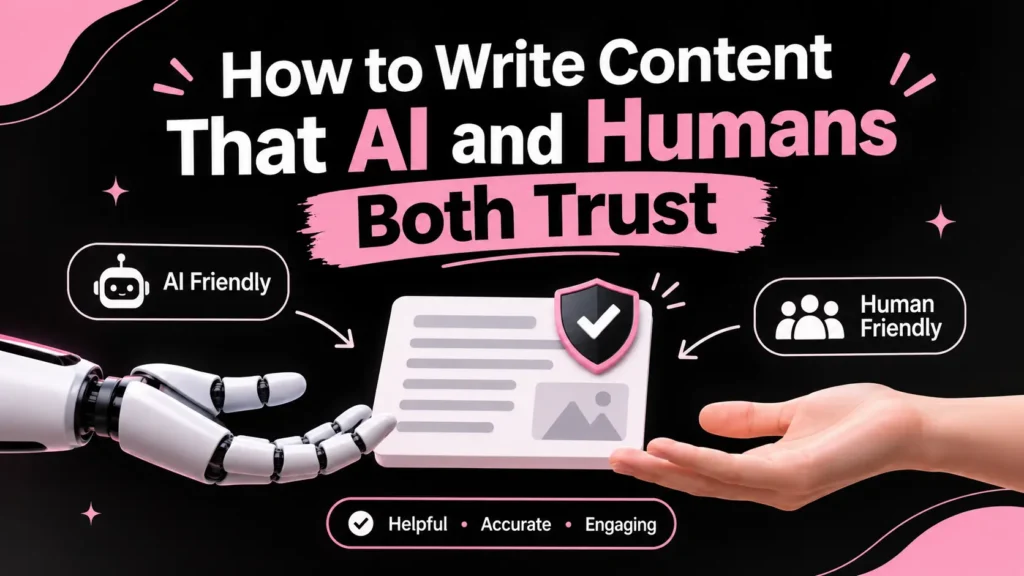
Search engines and AI assistants increasingly rely on the same qualities that make a page useful to people. When someone asks an AI tool a question, the answer often draws on pages that look credible. Writers who focus on quality are already doing most of the work.
Why Trust Matters More Than Ever
For years, many marketers wrote for keywords first and readers second. That approach can still bring traffic, but it is becoming less effective. AI tools summarize many pages at once, and a thin article that repeats what everyone else says is rarely worth citing.
Start With Real Experience
The E-E-A-T framework asks whether content shows experience, expertise, authoritativeness, and trustworthiness. Experience is the newest part. Readers want to know whether the author has actually done what the article describes. Did you run the campaign? Did you test the tool? Did you talk to customers who had the problem?
Share those details plainly. Describe what you tried, what failed, and what you would change. A sentence like “our first email subject line got a lower open rate than the second” is more convincing than a general tip about testing.
Show Who Stands Behind the Words
Every article should have a named author, a short bio, and links to other work. Explain why that person is qualified to write on the topic. A marketing director writing about budgets has a stronger claim than an anonymous team account.
Keep your about page accurate and current. Add contact details and a physical address if you have one. Trust grows when readers can see who is behind the brand.
Publish Original Data
Original data helps you stand out. When you publish numbers that exist nowhere else, other writers have a reason to cite you. You do not need a research lab for this. You can survey your email list, analyze your own analytics, track results across a set of campaigns, or run a short poll of customers.
Explain your method. State how many people responded, when you collected the data, and what its limits are. Readers can only evaluate findings they can see the method behind. Avoid rounding numbers to look more impressive, and report results that disappoint you as well as those that do not.
Use Expert Quotes Carefully
Expert quotes add outside perspective. Interview people in your field and ask specific questions. Get permission to publish their words, and confirm their job title and company. Quote them accurately and never stretch their meaning.
Combine expert voices with your own analysis. A page made only of quotes feels borrowed, while a page made only of opinion feels unsupported.
Cite Sources and Link Out
When you use facts from elsewhere, link to the original source. Government sites, academic studies, official platform documentation, and company reports are stronger than secondhand summaries. Linking out shows that you checked your work.
Confirm that your links still work and that the information is current. Outdated facts damage trust quickly, especially in fast-moving areas like search and advertising.
Write Clearly for People First
Clear writing helps every reader. Use short sentences where they fit. Answer the main question near the top. Write headings that describe what each section covers, and define technical terms the first time you use them.
Avoid exaggerated promises. Phrases like “guaranteed results” or “the only method that works” make readers doubt the rest of the page. Describe realistic outcomes and the conditions that affect them.
Keep Content Updated
Add a last updated date to articles on changing topics. Review your highest-traffic pages every few months, replace old data, fix broken links, and add examples from your recent experience.
A Simple Pre-Publishing Checklist
ng Checklist
Before you publish, confirm that the author is named and qualified. Check that every claim has a source or comes from your own experience. Make sure any data includes its method, and verify that expert quotes are accurate and approved. Finally, read the piece aloud and cut anything that sounds like filler.
Honest, specific, and useful content earns trust from readers and from the systems that increasingly summarize the web. Start with what you actually know, support it with evidence, and be clear about where your knowledge ends.